part one:
definition
among the seven different approaches to leadership that we have studied in the past two weeks, it has been suggested that we reflect upon the Situational Leadership approach for this week's blog entry. and i'm okay with that, because it's my favorite approach so far. i've really enjoyed thinking about this approach, and about this model:definition
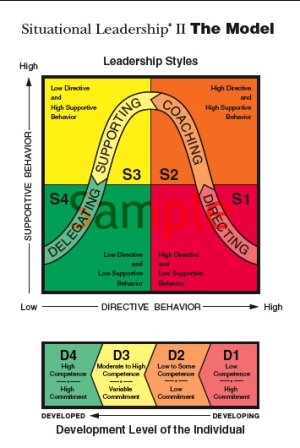
mostly for my own sake (and for that of my personal friends who are nice enough to read my little blog), let's briefly discuss the model above, which is comprised of two boxes and called Situational Leadership II (SLII).
first, the large box on top: this refers to the four different leadership styles which emerge based on whether a leader's behaviors are directive in nature (production-oriented), supportive in nature (relationship-oriented), or a combination thereof. each of the four styles is then neatly referred to as being high (or not) in one kind of behavior, or the other, in both or in neither. what we end up with are four quadrants, which represent the following leadership styles:
directing
coaching
supporting
delegating
and finally, each of the styles is labeled s1, s2, s3 and s4- the significance of which is to follow shortly.coaching
supporting
delegating
the second component of the SLII model is represented by the rectangular box below: the development level of the follower. the premise here is that development levels are a function of the employee's competence and commitment to a certain task and that competence and commitment fluctuate from task to task as well as over time. in the SLII model, an employee labeled D1 is developing (learning), while an employee labeled D4 is developed (doing).
the SLII model provides a prescriptive approach to leadership, allowing the leader to adopt the most effective style of leadership to compliment the development level of the follower. to do this, the leader must simply match up the leadership style (S1 through S4), to the follower's development level (D1 to D4). et voila: goal effectively attained.
now, let me put this out there: for my classmates who are reading this, i know that so far this has been neither insightful nor groundbreaking. but my own personal aim thus far was to see if I could explain the model to myself without consulting my notes or texts. and so this is what i've come up with. and at this point, i warmly welcome any input if i've messed it up somewhere along the way.
part two:
journey
journey
and so, while the Situational Leadership approach provides a framework to find the most effective leadership style for accomplishing any given task based on the follower's development level, it stops short of describing how to affect an employee's growth along the development level spectrum.

how can we best employ the directing style of leadership (S1)- warranted by employees who display low competency but high commitment for a certain task (D1), to encourage development? how can we move D1 to D2, essentially? is there an specific amount of time (days, weeks or months) throughout which the directing style should be implemented?
my feeling is that since the directing style is being employed for the benefit of followers who lack in specific task competency, it should be carried out fully and diligently (i.e., communication should remain a one-way street, where leaders announce solutions and decisions and closely supervise or monitor work progress). at some point, resulting from experience, levels of competency may in fact increase; it would be at this very point that leaders have an opportunity to solicit input, show some interest in their subordinate's ideas and listen to opinions of the follower hence facilitating their shift up to the next level of development.
now, with moderate ability (competency) and some willingness (commitment), the follower displaying level D2 necessitates a leadership style high in both directive behaviors and supportive behaviors (S2). this type of employee can be described as having lost a bit of their initial motivation since beginning the job, and therefore relies heavily on highly supportive behavior in order to experience growth along the development continuum. likewise, the emphasis of leadership throughout this phase of development should be on continuous directive behaviors in order to further allow growth in competency. this style, the coaching style, must go a long way to restore employees' commitment and willingness for a task.
at some point, detecting confidence and comfort as well as a new level of competency , it is up to the leader to relenquish a certain amount of responsibility for the task itself to the follower. a lessening in directive behaviors at this point can facilitate the shift to the next level.
the next level of development (D3) depicts a follower who is perhaps also a leader. perhaps we can envision a department head, who supervises a group of people undertaking a specific task. the department head still reports to the CEO or COO for example, but is the recipient of mostly supportive, and less directive behaviors. the leader in this case, the CEO or COO, ensures that the subordinate has the tools they need to succeed, and facilitates both problem-solving as well as the skills necessary for the tasks at hand. at this level of development, the follower is called upon for regular feedback as well as input.
during this phase, the quality of feedback and consistency of input can be gauged and measured as an indication of whether or not the follower is at the cusp of D4 and ready for a delegating approach to leadership, which entails the most autonomy in a follower as the style is low in both directive and supportive behaviors.
my two cents:
aside from flexibility, the Situational Leadership approach tells me that a leader needs to be completely attuned, interested and involved in the development of the follower. as i have already mentioned, since there is no clearly prescribed goalpost describing where exactly to change leadership styles, the leader must rely completely on observation, intuition and creativity while moving their team of followers from learners to doers.
aside from flexibility, the Situational Leadership approach tells me that a leader needs to be completely attuned, interested and involved in the development of the follower. as i have already mentioned, since there is no clearly prescribed goalpost describing where exactly to change leadership styles, the leader must rely completely on observation, intuition and creativity while moving their team of followers from learners to doers.


If you are doing all this from your memory and your comprehension of the readings, then you've GOTTEN IT! I love the graphic of the person on the mountain top (presumably).
ReplyDeleteManuel, you nailed this theory! :) Your insight into the "mechanics" of SitLead and how it "shows up" in the real world is impressive. You are absolutely correct that the model is prescriptive BUT requires managerial engagement with their followers if they are going to employ the model as a development tool. Great post!!
ReplyDelete